
Marketing Trends 2026 in Europe and Germany: Trust Wins in the Age of AI.
AI will make marketing faster in 2026 - but it also adds a lot of questions and concerns to our plate!
Across Europe (and especially in DACH - Germany, Austria, Switzerland), we’re seeing the same shift again and again: When brands start to create content with AI, everything starts looking the same and those brands are having a difficult time to stand out from competitors. This is why human content is getting more and more important.
In this post, we’re sharing the marketing trends we’re observing for 2026 - and what they mean for brands marketing into Europe.
1) Originality + personality will beat “AI sameness”
AI content creation is getting cheaper and faster. The result is predictable: more output, more repetition, more “same same” content - and audiences start to get tired of it.
Brandwatch’s 2026 trend reporting calls out the same phenomenon: authenticity becomes the differentiator in a “sea of AI slop.”
What this means for brands in 2026:
You don’t win by posting more. You win by being recognizable, human, and standing out next to others. It’s ALWAYS quality over quantity!
What we recommend:
Create content AI can’t easily replicate: f.e. work with real people over avatars created by AI.
Prioritize believability over volume: real examples, real numbers, real stories.
A simple test we like: Could any competitor post this tomorrow, and it would still make sense? If yes, it’s probably not distinctive enough.
2) Recommendations by AI agents will reshape discovery (and buying)
Have you ever used AI to find out which product to buy? We believe the answer is probably yes, and you are definitely not alone.
Kantar highlights that AI shopping assistants are already used by a meaningful share of AI users and that brands will increasingly have to “serve” both humans and non-human decision-makers.
That’s why social proof becomes even more important. Why? Because AI systems (and humans) need trust signals to decide what’s credible.
What we recommend brands focus on:
Reviews: Encourage your customers to share their stories and leave reviews
Community proof: Build a strong community where people start to interact with each other
Natural language content: write the way people actually speak and ask questions
If you are targeting an audience in Germany / DACH, please note that you should definitely hire someone or work with someone who speaks the language. In DACH, audiences are highly sensitive to anything that feels overly promotional and unnatural.
So if AI helps you translate faster, that’s great. But you still need a human layer to ensure the tone is how people actually speak, search, and judge credibility in the market.
3) It’s the era of niche and micro influencers
Smaller creators often have tighter bonds with their audience.
Yes, working with them means that you reach fewer people, but the quality of attention is often stronger because the relationship is stronger.
With Hey Stranger, this is also the strategy we have been working on with our clients - and the ROI outcomes are, of course, much better than when working with big influencers. (So this trend is definitely relevant for smaller brands, who are also a bit more budget and sales performance conscious)
In 2026, that relationship of the influencers and their audience matters more than ever because engagement is moving increasingly private: shares, saves, DMs!
What we recommend:
Micro/niche creator collaborations
Long-term collabs / multi-integration, not one-offs
(Consistency compounds credibility and performance.)
“What about AI influencers?”
This is where we’re very cautious - especially for Europe/DACH.
Influencer marketing works because people believe there’s a real human behind the content. Once that belief changes, the content may still get views, but trust will be gone! (Which you know is one of the most important aspects of marketing in the German-speaking markets)
4) Nostalgia is back (hello, 2016)
One of the first big cultural signals we’ve seen: the “2016 trend.” People are sharing life updates and photos from 10 years ago.
In times, where we often don’t know what’s real and what’s AI, it makes sense that people long for something that feels more familiar and human.
What brands can do:
We usually don’t recommend jumping on trends just to chase attention. But building with nostalgia as an emotional layer can help your content connect deeper.
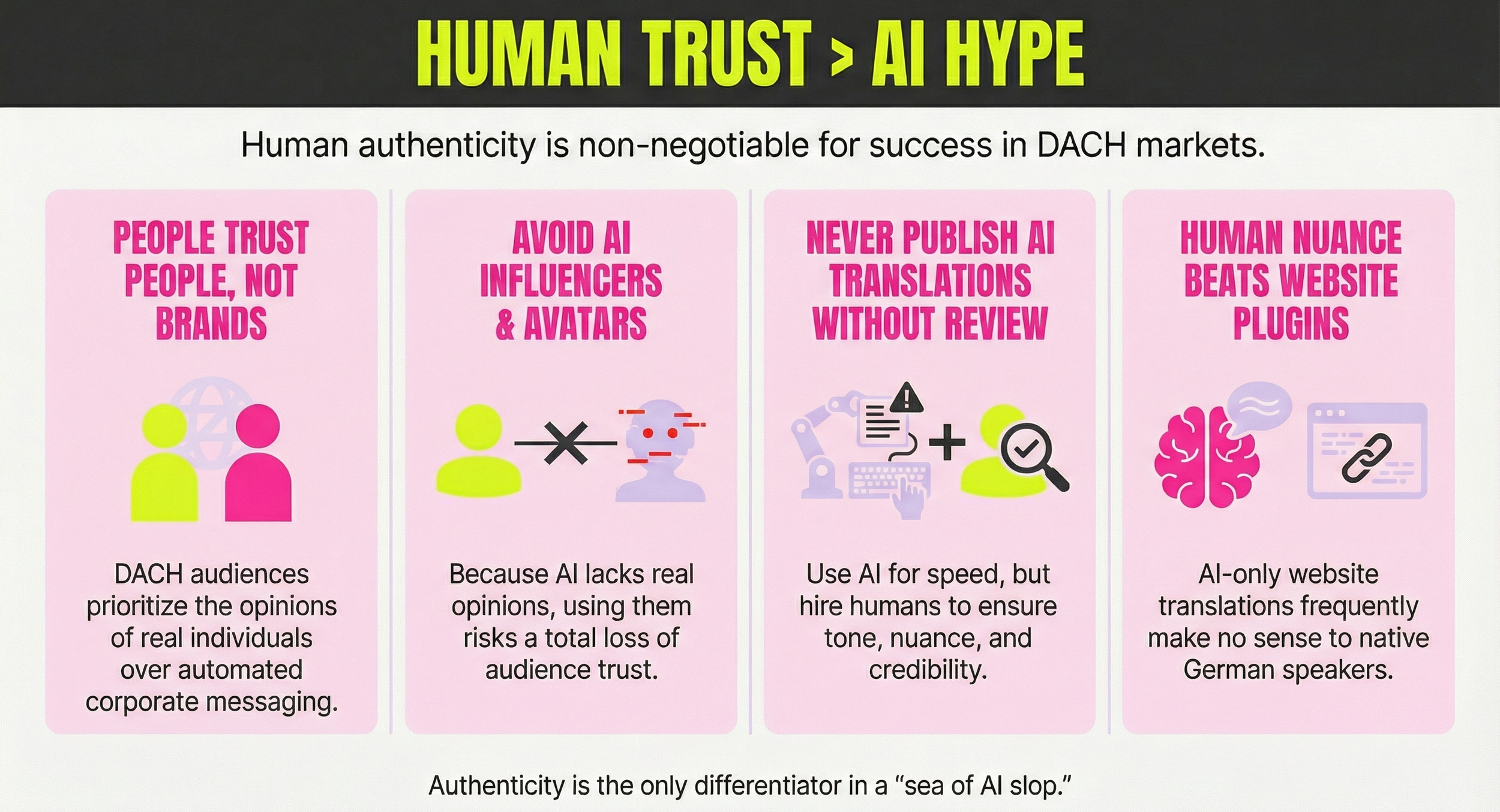
Some takeaways from this article
Are AI influencers effective in Europe / Germany?
In trust-driven markets like DACH, we recommend caution. People trust the opinion of actual people rather than the brand itself. By using AI influencers, there is a large risk of losing your audience’s trust as those AI avatars have no actual opinion and are following what your brand is telling them to say.
Is it okay to use AI to translate a website into German?
Use AI to speed up drafts, yes - but don’t publish without human review. Nuance, tone, and credibility matter a lot in German. Almost daily, we are seeing German websites that make no sense because they are translated with AI - so be cautious when using website translation plugins.

We at Hey Stranger are excited to see what the year 2026 brings - and we’re especially curious how brands balance efficiency with credibility.
Any questions to this article, reach out to us anytime~
