
AI x Marketing How we use AI at Hey Stranger (and where it can backfire in Germany)

AI is one of the most talked-about topics in marketing right now. Whether we are browsing social media, talking to other marketers, or onboarding new clients, it always comes up.
While some marketers worry that AI will replace their jobs, others assume that if you are not using AI, you are adding unnecessary workload. From our perspective at Hey Stranger, AI is definitely more than a “good to have”. It is a tool that can make marketing faster, more scalable, and more efficient, if it is guided by strong strategy and human judgment.
Why AI will not replace marketers
We have tested AI tools extensively, and one thing is clear: AI will not fully take over a marketer’s job.
To use AI well, someone still needs to provide:
Brand strategy (positioning, goals, tone of voice)
Target audience understanding (what people care about, what they reject, what language feels natural)
Quality control (checking if outputs are true, usable, and culturally appropriate)
AI can generate options. But a marketer decides what fits the brand, what is credible, and what will actually perform.
You can also see this in how we wrote this blog post. While the article is written by a human, we still use AI to improve clarity, fix typos, tighten structure, and make sure the content is easy to understand. This lets us keep the human insight while using AI as a helpful assistant for format and precision.
A common mistake we see with global brands: trusting AI to do the whole marketing
One pattern we observe a lot, especially when working with Asian brands, is the belief that AI can do “the whole marketing” and that spending on marketing would be wasteful.
This is extremely risky when brands target overseas audiences with different cultures and languages. What often happens is that brands apply their local strategy, let AI handle the rest, and then launch content without fully understanding whether it makes sense, matches the overseas audience, or is culturally appropriate.
What is usually missing when brands over-trust AI
When brands rely on AI too heavily, four gaps show up again and again.
1) Prompts without market understanding
Many companies start using AI in marketing immediately, without doing the groundwork first. They skip market research, don’t validate assumptions, and then expect AI to “adapt” to the market just because they mention a country in the prompt. In reality, AI can only work with what you give it. If your input is based on generic assumptions, the output will also be generic and often off for the local audience.
2) Prompts without target audience insight
If you do not understand the target audience, it is almost impossible to prompt relevant ideas. For example, if a Taiwanese marketer plans a campaign for Germany but does not understand the DACH audience, culture, or humor, it becomes difficult to come up with a direction for AI. The prompts will be generic, and the output will not feel local.
3) Using AI results without checking
A big issue is that AI output is often used directly without proper review. This leads to unclear websites and content outputs, especially in a global context. We are seeing many German websites that make no sense at all and are obviously translated through AI. Sometimes even simple wording can shift meaning dramatically.
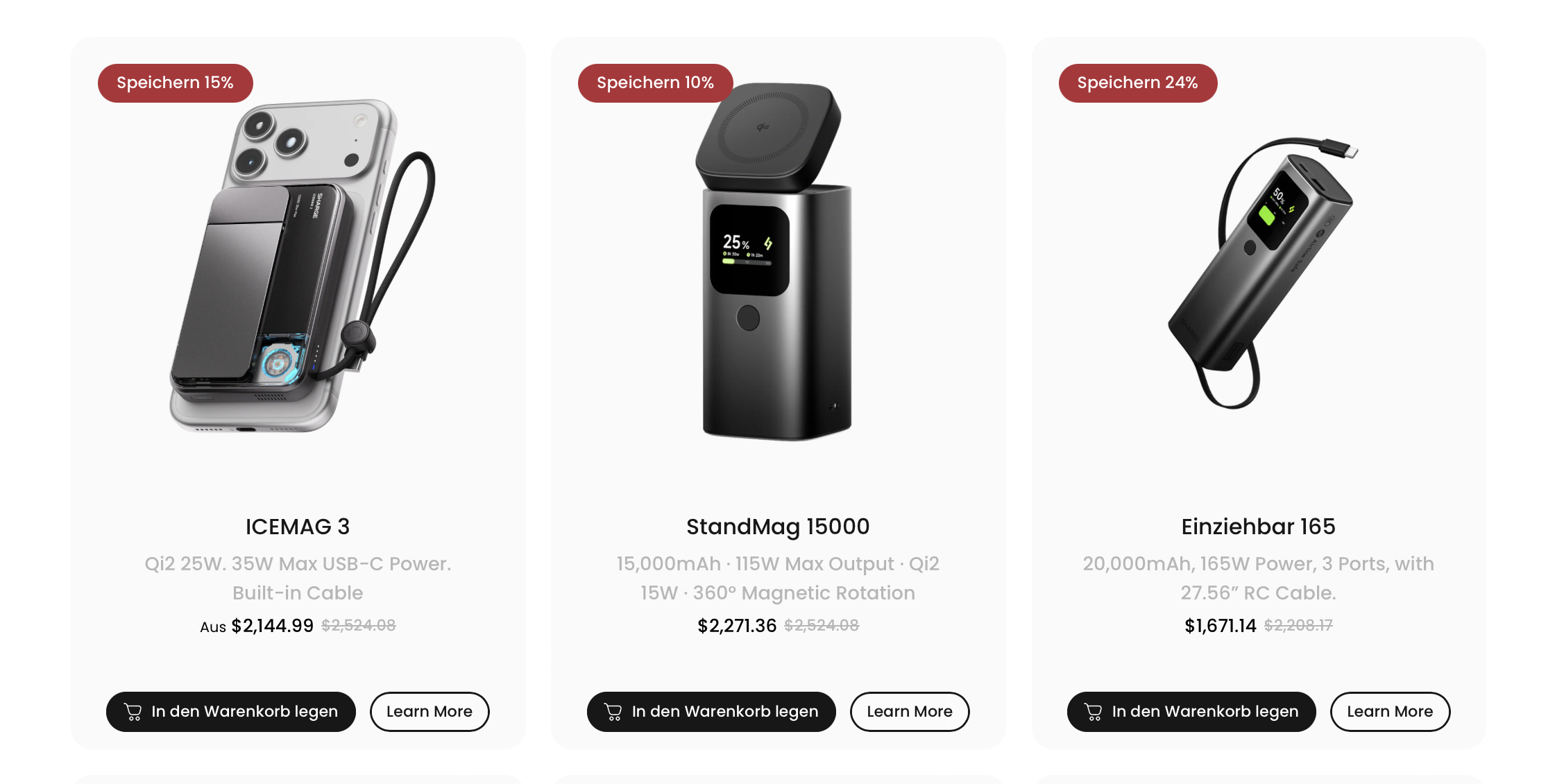
For example, the phrase “Save money” can end up translated in a way that suggests “store money” as shown on the example below. In German, that can create confusion instantly and it signals low quality or low credibility.
Similarly, the product name “Retractable 165” sounds fine in English, but the German equivalent “Einziehbar 165” as a literal translation is unsuitable in German and not in line with the brand’s style and other product names. It almost sounds a bit like an IKEA product name, which often loosely relate to the product's shape or function (e.g the screw set called “Fixa”).
4) Cultural appropriateness is not guaranteed
Not everything generated by AI is culturally appropriate. That is why it is important to work with marketers who understand the target market well enough to avoid backlash and protect brand trust.
AI influencers: why this can be risky in the DACH market
AI influencers seem more accepted in parts of Asia, but in Germany they can seriously damage a brand.
Think about it this way. A brand creates an avatar, and that avatar says the product or brand is great. From a German perspective, this can feel like faking a review. You are pretending that a person likes your brand, while the information is coming from the brand itself.
This is one of the most risky things you can do in the DACH market, where credibility is crucial for brand building and marketing. If the audience feels tricked, the brand instantly becomes less trustworthy.
How we use AI at Hey Stranger
We use AI to make recurring processes smoother and more scalable, but we keep strategy, creative direction, and relationship-based work human-led.
We also want to highlight that creator and influencer marketing is an area where we fully value human interaction. We do not recommend having AI bots talking to influencers or partners. Honest communication and real relationships lead to better results.
AI for base translations in localization
At Hey Stranger, we use AI for base translations when doing localizations. AI gives us a solid starting point and speeds up the localization process.
However, we never publish AI translations as-is, and we would not recommend any brand to do so. Even after trying many AI tools and working on branded GPT setups on OpenAI, we still see a clear difference. Content feels different when it comes from AI, and German sentence structure often sounds unnatural because it follows the logic of the original language too closely.
AI for inspiration, hooks, and CTAs
We also use AI to support brainstorming when we already have an initial idea and strategy. It can be helpful for finding a stronger hook, improving a CTA, or generating variations we can evaluate and refine.
AI for paid media keyword research
AI can also be helpful in the brainstorming phase of paid media keyword research. We usually start with our own lists and then use AI as an assistant to double-check if we missed relevant keywords. It also helps us generate long-tail keywords based on our short-tail keywords.
AI as a learning partner for technical tasks
Lastly, we often treat AI like another colleague in the team who can train us in tasks we are not yet familiar with. Whether it is website coding, support with spreadsheet formulas, or writing small scripts, AI helps us learn faster and solve problems more efficiently.
Overall, AI is a great helper for reoccurring tasks and helps us to be more efficient and able to focus more on strategy and creative work.
Why we are careful with AI in ads and content for the DACH market
The German-speaking DACH market is often a hard nut to crack. It takes time to win trust. That is why credibility needs to be considered in every marketing output.
AI can invent details and overpromise
We have tested AI in visual ad content creation and saw AI add elements that were not part of the offer, simply to make the ad sound more appealing. In the DACH market, overpromising can be a trust destroyer because it looks like the brand is misleading its audience.
AI content can make brands look generic
In a market where many brands sell similar products, using AI for content creation can make it even harder to stand out. If you want to be different, we recommend more human content, such as:
sharing team insights
talking about your values
showing behind-the-scenes
adding real customer context
Conclusion
AI helps marketing teams move faster, scale processes, and reduce repetitive work. But it does not replace strategy, target audience understanding, cultural nuance, and quality control. Especially in the DACH market, AI works best when humans lead and AI supports.
